

Common Running Injuries
in NYC

What Causes Them and How Runners Can Prevent Them
Running is simple.But the forces involved are not.
Every stride places five to eight times your bodyweight through a single leg. Multiply that across thousands of steps per run and the body must absorb and redistribute an enormous amount of load.
When the system managing that load breaks down, injury usually follows.
At Moment Physical Therapy & Performance, we help runners across NYC identify the underlying causes of injury, restore strength and movement efficiency, and build durability that supports long-term training.
Because the goal is not just getting out of pain.
It’s staying healthy enough to keep running.
Why Running Injuries Happen
Most running injuries are not caused by a single event.
They develop gradually when training stress exceeds the body’s ability to adapt.
Common contributing factors include:
rapid increases in mileage or intensity
stride mechanics that create inefficient force distribution
limited strength in key stabilizing muscles
mobility restrictions that alter movement patterns
incomplete recovery between training sessions
When these factors accumulate, the body compensates until a tissue eventually reaches its breaking point.
Pain is the signal.
But the underlying cause is usually a combination of load, mechanics, and strength.

The Most Common Running Injuries
While runners experience a wide range of issues, several injuries appear far more frequently than others.
Understanding how they develop helps runners intervene early and return to training faster.
Runner’s Knee and IT Band Syndrome
Pain around the front or outside of the knee is one of the most common complaints among runners.
Often this irritation develops when the knee absorbs more stress than the surrounding muscles are prepared to handle.
Common contributing factors include:
weak hip stabilizers
poor control during landing
stride mechanics that increase lateral knee stress
downhill running overload
Addressing these issues typically requires strengthening the hip and improving control of how the leg absorbs impact during each step.

Achilles Tendinopathy
Achilles irritation is extremely common among runners increasing mileage or introducing speed work.
The Achilles tendon acts like a spring during running, storing and releasing energy with each stride.
When tendon load increases faster than the tissue adapts, symptoms can appear.
Common contributors include:
sudden mileage increases
reduced ankle mobility
calf strength deficits
changes in footwear or terrain
Progressive tendon loading is one of the most effective strategies for restoring resilience in the Achilles.
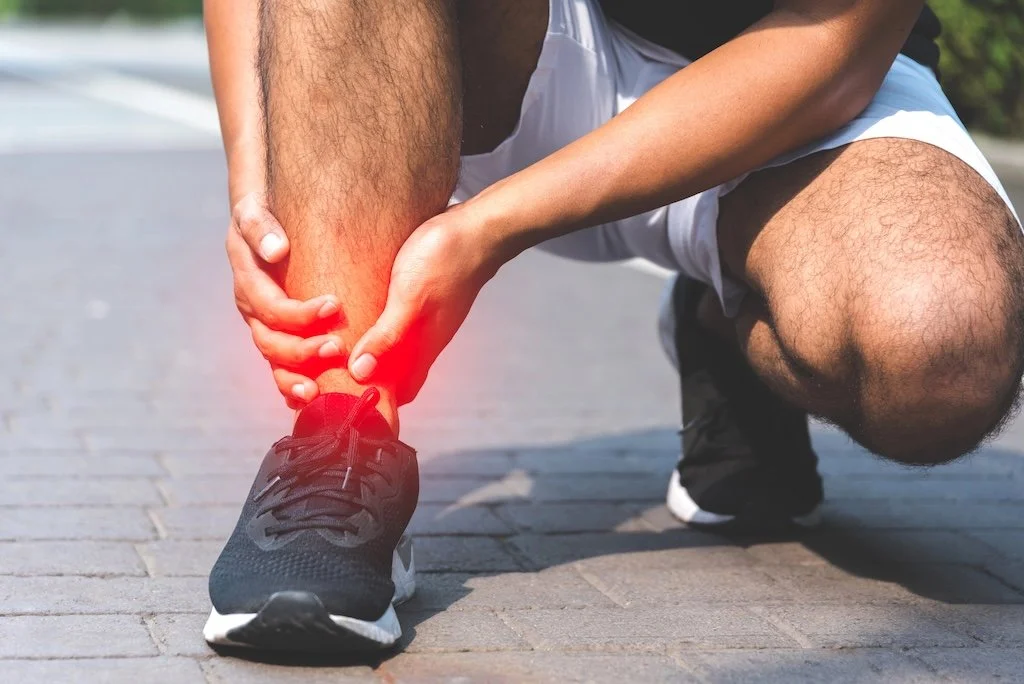
Plantar Fasciitis
Heel pain that appears during the first few steps in the morning or after long runs is often associated with plantar fascia irritation.
Although the pain is felt in the foot, the cause often involves the entire kinetic chain.
Factors may include:
tight or weak calf muscles
reduced foot strength
repetitive loading without adequate recovery
Restoring strength and improving load tolerance through the foot and calf complex often resolves the underlying issue.

Hamstring and Calf Strains
Muscle strains typically occur when speed increases or fatigue alters running mechanics.
As runners become tired, force distribution changes and muscles are asked to absorb more load than they are prepared for.
Prevention strategies often focus on:
eccentric strength development
sprint mechanics
improved coordination under fatigue

Preventing Running Injuries
Injury prevention is not about avoiding stress.
It is about preparing the body to tolerate it.
Successful runners consistently develop three qualities:
1. Strength That Supports Each Stride
Strong hips, calves, and trunk muscles reduce unnecessary stress on joints and connective tissue.
Many runners benefit from structured strength development through runner-specific programs designed to support mileage and performance
2. Mobility That Transfers to Running
Running requires specific movement access.
Limited ankle mobility can alter ground contact. Restricted hip extension can shorten stride and increase compensation elsewhere.
Mobility work must integrate with strength and movement patterns in order to improve running mechanics.
3. Understanding Your Mechanics
Small inefficiencies repeated thousands of times can create significant stress.
Evaluating running mechanics through running gait analysis can help identify asymmetries or stride patterns contributing to recurring injuries
When Injury Interrupts Training
Even the most disciplined runners encounter setbacks.
The key is addressing the problem correctly the first time.
Returning too quickly without rebuilding strength and movement capacity often leads to recurring issues.
Our structured approach to returning to running after injury helps athletes rebuild gradually while restoring the strength and confidence needed for long-term success
Keep Running Without the Cycle of Injury
Running should not feel like a constant cycle of breakdown and recovery.
With the right strength, mechanics, and training progression, runners can build durability that supports years of consistent training.
If you’re dealing with a running injury or want to prevent the next one before it starts, we’re here to help.
Schedule your first session and get back to running with confidence.