Return to Sport Physical Therapy in NYC Built for Performance, Not Just Recovery
Why Traditional Return to Sport Falls Short
Most athletes are cleared when pain decreases, not when performance is restored.
That gap is where reinjury, hesitation, and stalled progress live.
Traditional rehab often misses what actually determines readiness:
Objective measurement of real force production and asymmetry
Strength and conditioning that prepares you for real sport demands
Mobility that transfers to movement, not just flexibility on a table
Clinicians trained in biomechanics, performance, and return-to-sport decision making
A system designed to uncover hidden deficits before they become future injuries
At Moment, return to sport is not a timeline. It is a standard.
Objective Testing That Removes Guesswork
Returning to sport should never rely on feel alone. When necessary, we use precise performance testing to measure readiness, identify asymmetries, and guide progression.
Force Plate Testing
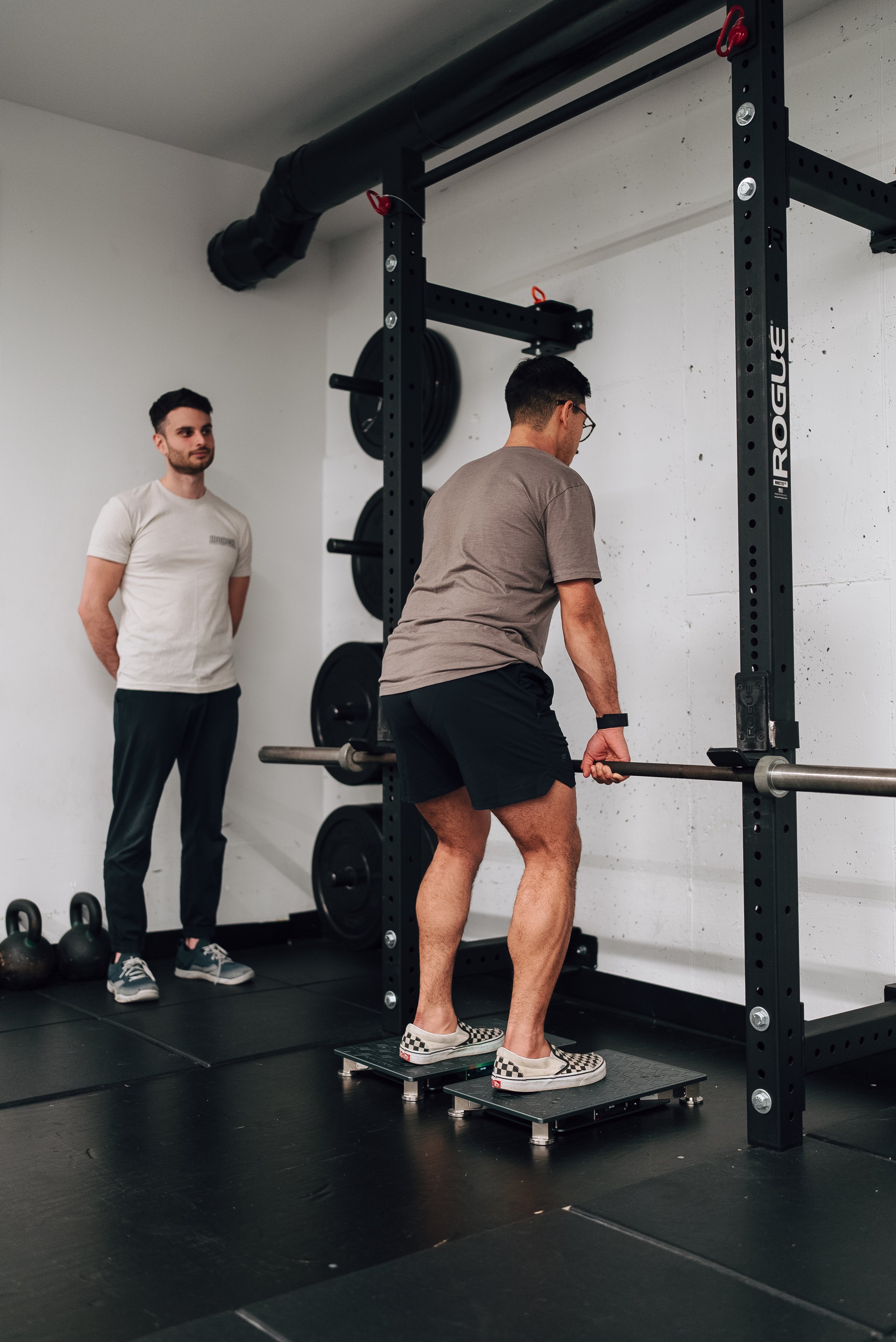
Using technology often reserved for professional teams, our force plate testing measures how your body produces and absorbs force during dynamic movement.
-
During jumps and dynamic movements, the force plate captures how much force each limb produces and absorbs. This reveals not just total output, but how evenly your body distributes load.
Paired with motion analysis, we can see the movement strategies behind that force. Athletes compensate extremely well. When asymmetries go uncorrected, they often become the source of persistent symptoms or future injury.
-
Comparing only to your uninvolved side can be misleading. Reduced activity during rehab often deconditions the “healthy” limb, making it a poor benchmark for true readiness.
We compare your data to research-backed normative values and a global athlete database, ensuring return to sport decisions are based on objective performance standards, not compromised baselines.
-
After injury, the body adapts by shifting load and altering movement to protect vulnerable areas. While helpful short term, these strategies often create uneven stress over time.
This imbalance increases the risk of overuse or reinjury, as seen in ACL and Achilles research. Force plate testing pinpoints asymmetries early so they can be corrected during rehab, not after a setback.


Force Dynamometry
Whole-body movement tells part of the story. Isolated strength tells the rest.
Our Force Dynamometry Testing measures joint-specific force production with clinical precision. This reveals deficits that manual resistance testing cannot detect.
-
Pushing against someone’s hand is not an accurate way to measure how much force you can produce from a specific joint. That’s why objective testing, such as force dynamometer testing, is so valuable—it gives us measurable insight into strength deficits that may otherwise go unnoticed. If this capacity is not fully restored, injury risk can increase significantly.
-
Safe return to running, cutting, and sport requires meeting measurable strength standards. There are evidence-based thresholds that must be reached before progressing to higher-demand activities.
Using research-backed normative values and clinical benchmarks, we determine when you are ready to advance and when further strengthening is required. Progression is based on data, not timelines.
-
Think of each muscle and joint as a tool. If a tool is damaged but never fully repaired, every task that depends on it becomes compromised.
If isolated strength is not restored, the body compensates during more complex movements. Over time, this increases mechanical stress and injury risk.
You cannot demand performance from a muscle that cannot produce force independently. Isolated testing ensures each component is restored before expecting full-system performance.


Strength and Conditioning That Transfers to Sport
Being cleared is not the same as being prepared.
Our Strength and Conditioning approach bridges the gap between rehab and performance by preparing your body for speed, load, fatigue, and decision making.
Every program is individualized and built around your capabilities, not your diagnosis.
-
Many rehab programs rely on generic progressions that fail to challenge athletes at the level their sport demands. Repeating basic exercises without meaningful progression does not prepare you for real performance.
Our programming is built around your capabilities, not your diagnosis. No two injuries, surgeries, or athletic backgrounds are the same. Your training reflects your history, your sport, and your current performance level.
Individualized progression is not optional. It is required.
-
Performance is not just about getting stronger. It is about producing the right qualities at the right time.
Can you generate enough force?
Can you generate it quickly?
Can you produce it in positions that mirror your sport?We assess the specific deficits limiting your performance and build training that directly targets those gaps. With a foundation in both rehabilitation and strength and conditioning, we design programming that translates beyond the clinic and into real competition.
-
Every sport places unique demands on the body. Even within the same sport, different positions require different qualities.
We begin with your end goal and work backward. What does your sport demand? What does your position require? What physical qualities must be present under fatigue?
Your training is structured to meet those demands and then build beyond them. The goal is not just to return you to baseline, but to create a performance buffer that reduces future risk and elevates your ceiling.


Advanced Mobility Training
We take a full body approach to mobility training to make sure that you can access to the positions that you need to get into under high demand. Everything needs to scale beyond basic stretching to make sure you can access positions beyond laying on a table.
-
Most mobility work happens in isolation and never translates to real movement. Stretching without integration does not prepare you for sprinting, cutting, lifting, or changing direction under load.
Mobility must reflect how the body actually moves. It must transfer into positions of demand, not just positions of comfort.
At Moment, mobility is trained within movement so it carries over into performance.
-
After injury, the body adapts. New movement strategies emerge to protect sensitive areas, but these compensations often create restrictions in joints, muscles, and connective tissue.
If those patterns remain, mobility becomes limited and movement efficiency declines. Over time, this increases stress on other structures and raises injury risk.
We identify where compensations exist and restore mobility in a way that supports clean, coordinated movement rather than temporary flexibility.
-
Performance is never limited by a single factor. Mobility, strength, coordination, and control are always connected.
It is rarely just a mobility issue.
It is rarely just a strength issue.
It is rarely just a coordination issue.Our process identifies the key links influencing how you move and how you perform. From there, we build a plan that restores access to positions, improves movement quality, and supports long-term athletic performance.


Who This Is Built For
Our return to sport programming is designed for:
Athletes who have been cleared but do not feel fully ready
Athletes returning from ACL, Achilles, shoulder, knee, or hip injury
Runners, lifters, and field athletes rebuilding performance capacity
Active adults who want confidence, not just pain relief
Athletes tired of generic rehab and looking for a higher standard
If you feel “functional” but not fully capable, this is where true return begins.
The Moment Return to Sport System
Recovery is not the finish line. Performance is.
At Moment, return to sport follows a clear progression:
Restore movement quality
Rebuild strength and force production
Reintegrate speed, load, and coordination
Confirm readiness with objective testing
Return with confidence and resilience
This is how athletes stop protecting their body and start trusting it again.
Return to Sport With Confidence
If you are serious about returning to sport without hesitation, without hidden deficits, and without unnecessary setbacks, the next step is a performance-based evaluation.
At Moment Physical Therapy and Performance in NYC, we combine objective testing, individualized training, and movement expertise to ensure your return is complete, not partial.
Schedule your first session and begin the process of returning stronger, more prepared, and fully confident in your body.
Real performance is built on measurable progress, not guesswork. Our athletes return stronger, more confident, and better prepared for the demands of their sport.