
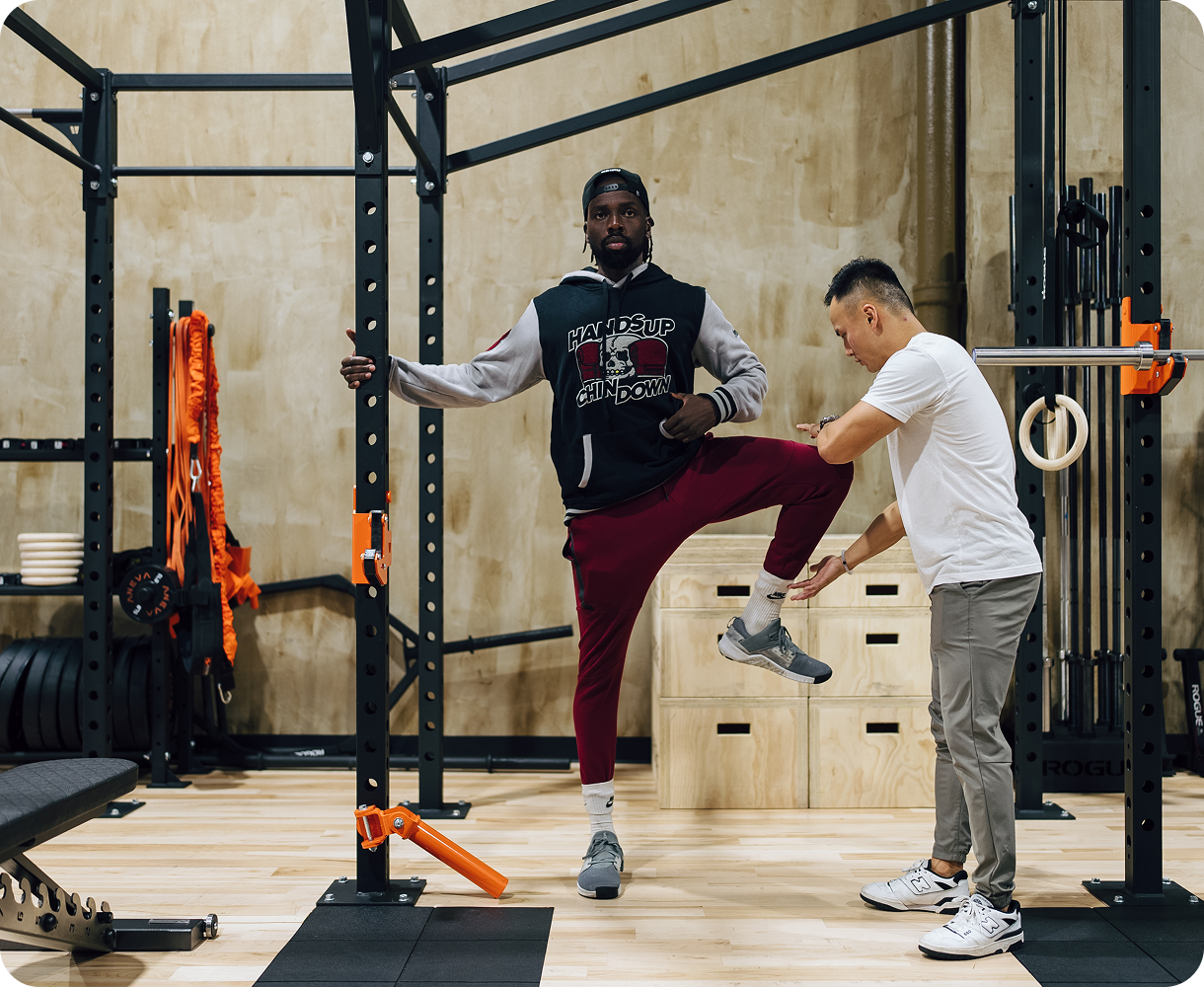
Knee Osteoarthritis Physical Therapy in NYC
A knee osteoarthritis diagnosis is not a verdict to slow down. Exercise is the most effective treatment available for knee OA, and the active adults who stay in motion consistently do better than those who protect the joint into decline. Built for people who have no intention of stopping.
UNDERSTANDING THE CONDITION
Understanding knee osteoarthritis
Knee osteoarthritis is a condition involving the gradual breakdown of the cartilage that cushions the joint, along with changes to the underlying bone and surrounding soft tissue. It is often described to patients as wear and tear, a phrase that is not entirely wrong but is frequently misunderstood in a way that leads people toward exactly the wrong response.
The wear and tear framing implies a simple mechanical model: the joint has a finite amount of use in it, and activity spends that use down faster. This model does not hold up against the evidence. Joint tissue is metabolically active and responds to load throughout life, not unlike bone and muscle. Appropriate loading stimulates cartilage health and supports the tissue that surrounds and protects the joint. The absence of loading does the opposite. Adults who reduce activity to protect an arthritic knee typically see the muscles supporting that knee weaken, which increases the load the joint itself has to absorb during daily movement, and the condition and its symptoms often progress faster, not slower, as a result.
Knee OA is common. It becomes more prevalent with age, and by a person's 60’s a significant portion of the population has some degree of cartilage change visible on imaging, including many people who have no pain at all. This is a critical point: the severity of changes visible on an X-ray or MRI correlates poorly with the severity of symptoms a person actually experiences. Two people with nearly identical imaging findings can have completely different levels of pain and function, which tells us that how the joint is being supported and loaded matters as much as, if not more than, the degree of structural change itself.
A diagnosis of knee osteoarthritis describes a joint that has changed. It does not describe a joint that has to stop working. What determines your function and your pain going forward is how well the muscles around that joint are supporting it, not the imaging report on file.
RECOGNIZING IT
Common symptoms of knee osteoarthritis
Knee OA symptoms typically develop gradually and are frequently dismissed early on as ordinary aging or as the accumulated effect of an active lifestyle, which delays proper evaluation and the intervention that would be most effective.
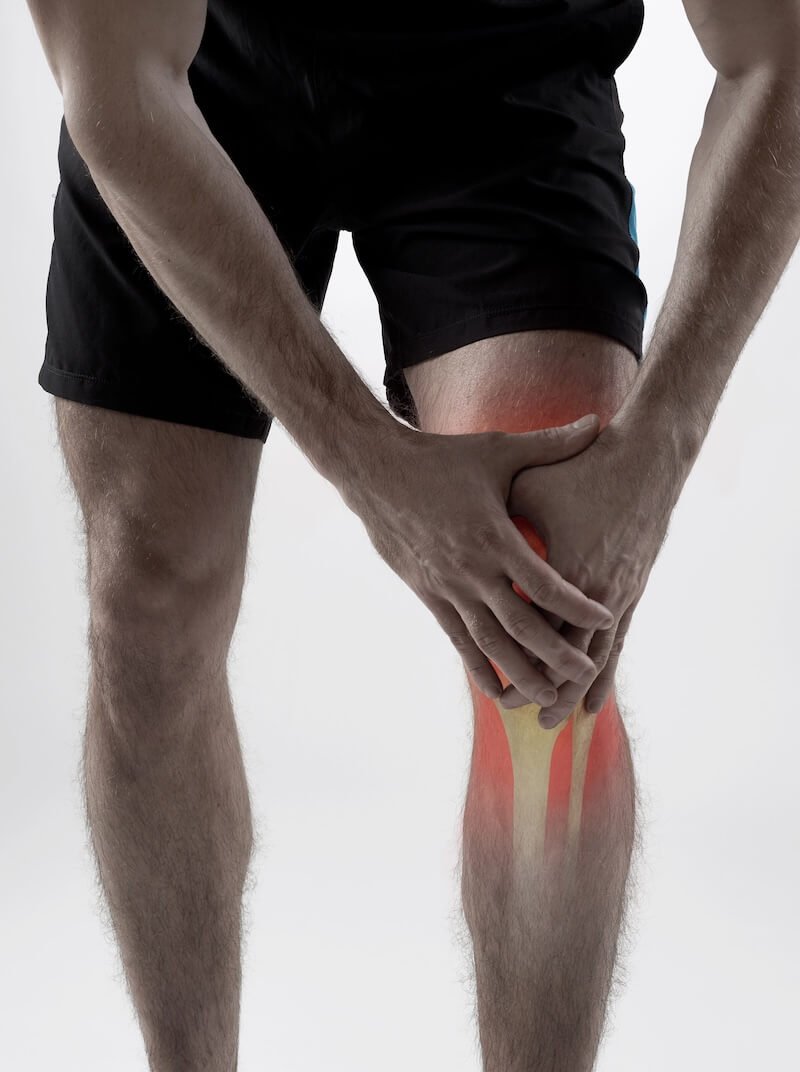
The most common presentation is a deep, aching pain that is worse with activity and improves with rest, though in more advanced presentations pain can become present even at rest and disrupt sleep. Morning stiffness that improves within about thirty minutes of moving is characteristic of OA and helps distinguish it from inflammatory joint conditions, where morning stiffness tends to be more prolonged.
Other common features include a sensation of grinding, clicking, or crunching during movement, known as crepitus, which is common and not in itself a sign of a serious problem. Swelling that fluctuates with activity level, a feeling of stiffness after periods of sitting, and a gradual reduction in the range of motion available at the knee, particularly full extension and deep flexion, are also frequently reported. Many active adults notice symptoms first in specific movements, descending stairs, getting up from a low chair, or the bottom portion of a squat, before the condition affects walking or daily function more broadly.
It is worth repeating that the presence of these symptoms, even when confirmed by imaging showing OA changes, does not tell us how much function is realistically available to you. That is determined through evaluation of strength, movement quality, and how the knee responds to load, not through the imaging report alone.
THE CENTRAL ARGUMENT
Why movement matters more than rest
The evidence supporting exercise as the primary treatment for knee osteoarthritis is among the most consistent and least ambiguous in all of orthopedic rehabilitation. Every major clinical guideline for knee OA management, from professional societies across multiple countries, lists exercise and strength training as first-line treatment, ahead of medication and well ahead of surgical intervention for most presentations.
Despite this, the instinct among many patients and, frustratingly, some providers, is still to recommend rest and activity avoidance once a knee OA diagnosis is made. This is precisely backward. Reducing activity to protect an arthritic knee sets off a cycle: the muscles that support the joint weaken from disuse, which increases the load the joint has to absorb unassisted during any activity that does occur, which increases pain, which further discourages activity. Over months and years, this cycle is a significant driver of the functional decline that gets attributed to the arthritis itself, when much of it is actually attributable to the deconditioning that followed the diagnosis.
| What Most People Are Told | What the Evidence Shows |
|---|---|
| Rest the joint to protect what cartilage remains. | Appropriate loading supports joint health. Prolonged rest accelerates the muscle weakness that increases load on the joint. |
| Your X-ray shows arthritis, so that explains the pain. | Imaging severity correlates poorly with symptom severity. Many people with significant OA findings have little or no pain. |
| High-impact activity will wear down the joint faster. | Runners do not show higher rates of knee OA than non-runners in large population studies. Strength and control matter more than impact alone. |
| Surgery is inevitable once OA is diagnosed. | Most people with knee OA manage effectively long-term with exercise and never require surgery. |
| Once it hurts, you should stop that activity for good. | Pain during a specific movement usually indicates a current capacity limit, not permanent damage. Capacity can be rebuilt. |
THE RESEARCH THAT SHOULD CHANGE HOW OA IS DISCUSSED
Exercise is the most effective treatment available for knee osteoarthritis. That is not a wellness talking point. It is the consistent finding across the clinical evidence base, and it is the foundation of how we approach every OA patient at Moment.
1st-line
Exercise and strength training, per every major clinical guideline
0
Correlation strength between imaging severity and symptom severity
Most
Knee OA patients manage long-term without ever needing surgery
Strength training with knee osteoarthritis
Strengthening the muscles that support the knee, particularly the quadriceps, is the single highest-leverage intervention available for knee OA. Stronger quads reduce the amount of force transmitted directly through the joint surfaces during walking, stairs, and other daily movements, which reduces both pain and the progressive load that contributes to further joint change.
This is not a small or subtle effect. Research comparing quad strength to knee OA symptoms and progression consistently finds that stronger quads are associated with less pain, better function, and slower progression of the condition. This relationship holds even in people with significant structural changes visible on imaging, which reinforces the point that the muscular support around the joint matters enormously, independent of the degree of cartilage change already present.
Strength training for an arthritic knee follows the same principles as strength training for any joint, applied thoughtfully to the individual's current tolerance and starting point. This typically begins with movements and loads the knee can currently manage without significant symptom flare, and progresses systematically as strength and tolerance build. For a deconditioned knee, this might start with body weight or lightly loaded closed-chain movements. For an active adult who has kept some baseline strength, it often means directly addressing the barbell squat, leg press, and single-leg work the person is already trying to do, refining the technique and load progression rather than avoiding those movements altogether.
Hip and ankle strength are addressed alongside knee-specific work, since deficits at either joint change how load is distributed through the knee during functional movement. A comprehensive strength program for knee OA is a lower extremity program, not an isolated set of knee exercises.
THE QUESTION EVERY ACTIVE ADULT ASKS
Can you still run with knee osteoarthritis?
This is one of the most common questions we hear from active adults with a new OA diagnosis, and the answer surprises most people: for many, yes.
The historical assumption that running accelerates knee osteoarthritis has not held up under scrutiny. Large population studies comparing runners to non-runners have consistently failed to find higher rates of knee OA in runners, and some have found lower rates among recreational runners compared to sedentary populations. This does not mean running is risk-free for every individual with knee OA, but it does mean that a blanket recommendation to stop running the moment OA is diagnosed is not supported by the evidence and may do more harm than good by removing an activity the person could likely continue with appropriate support.
Whether running remains appropriate for a specific individual with knee OA depends on factors that require an actual evaluation to determine: current strength and movement quality, how the knee responds to running-specific loading, the severity and location of joint changes, and how symptoms have been trending. Some runners with knee OA continue training with modifications to volume or surface. Others benefit from a period of strength building before returning to running. A smaller number find that running is not the right activity for their specific presentation, in which case identifying other high-value activity that the person can pursue with confidence becomes the priority.
The principle that guides this decision is the same one that guides the rest of OA management: the goal is to find the version of activity that is appropriate right now and expand it as capacity builds, not to default to avoidance because a diagnosis sounds more serious than the actual functional picture warrants.
Activity modification for knee OA is not the same as activity avoidance, and the distinction matters enormously. The goal of thoughtful modification is to keep a person as active as possible while managing the specific variables that are provoking symptoms, rather than removing entire categories of movement out of general caution.
Activity modification done right
Adjust volume before eliminating the activity
A runner whose knee flares at high weekly mileage may do well at a reduced volume rather than stopping running entirely. Small adjustments in dose are often more effective and more sustainable than all-or-nothing choices.
Modify range before avoiding the movement
A lifter who is symptomatic in the deepest portion of a squat can often continue squatting through a range that is currently well-tolerated while working to expand that range over time.
Address footwear and surface
For some individuals, surface and footwear meaningfully affect symptom provocation. This is a reasonable variable to adjust before assuming the activity itself is the problem.
Build capacity in parallel
Rather than permanently avoiding a symptomatic movement, build the strength and control to eventually tolerate it again, using currently tolerable variations in the meantime.
Distinguish flare-up management from long-term restriction
A short period of reduced load during an acute flare is reasonable. Treating every flare as evidence that an activity must be abandoned long-term usually is not.
Reassess regularly rather than deciding once
What a knee can tolerate today is not a fixed ceiling. As strength and movement quality improve through rehabilitation, the appropriate activity level often expands meaningfully.
SMART ADJUSTMENTS, NOT BLANKET RESTRICTIONS
HOW WE TREAT IT
How physical therapy helps active adults with knee OA
Many of the active adults who come to us with knee osteoarthritis have been told their options are medication, injections, or eventually surgery, without ever having completed a genuinely rigorous course of physical therapy. This is one of the most common and most consequential gaps in how knee OA is managed, and closing it is often where the most meaningful progress happens.
Evaluation begins with a full assessment of strength, particularly of the quadriceps and hip musculature, movement quality during functional and sport-relevant tasks, and how the knee responds to graded loading. This tells us far more about what you are actually capable of than the imaging report does, and it becomes the foundation for a program built around your specific deficits and your specific goals, whether that is returning to running, continuing to lift, or simply moving through daily life without the fear that every twinge signals further damage.
Treatment centers on progressive strengthening, addressed at a starting point that respects your current tolerance and advanced systematically as capacity builds. Manual therapy and targeted mobility work address any restrictions that are limiting movement quality or forcing compensations that increase joint stress. Activity-specific guidance helps you understand which modifications are genuinely useful and which restrictions you have been carrying unnecessarily.
Throughout the process, the goal is not simply pain reduction. It is rebuilding the confidence and physical capacity to move without hesitation, to trust the knee again during the activities that matter to you, and to understand that a diagnosis on paper does not have to define what you are capable of.
WHAT WE TELL EVERY ACTIVE ADULT WITH A NEW OA DIAGNOSIS
This diagnosis describes a joint that has changed. It does not describe a ceiling on what you can do. The people who do best with knee OA long-term are not the ones who protected the joint into decline. They are the ones who built the strength to keep asking more of it.
FREQUENTLY ASKED QUESTIONS
Common questions about knee osteoarthritis
-
Yes, for the large majority of people, and it is specifically recommended as first-line treatment by every major clinical guideline for knee OA. The key is choosing and progressing exercise appropriately for your current capacity rather than avoiding it out of general caution. A proper evaluation identifies what your knee can currently tolerate and builds a program from there, rather than defaulting to a blanket restriction that is not supported by the evidence.
-
Appropriately dosed exercise does not accelerate knee osteoarthritis and is consistently associated with better outcomes, including less pain and slower functional decline, compared to inactivity. What can provoke symptoms is a rapid increase in load that exceeds your current tolerance, which is a dosing issue, not a reason to avoid exercise altogether. This is exactly why working with someone who can calibrate that dosing to your specific knee matters.
-
Most people with knee osteoarthritis manage effectively long-term without surgery. Surgical options like knee replacement are typically reserved for more advanced presentations where conservative management, including a genuinely rigorous course of strength-focused physical therapy, has not provided adequate relief. Many people who are told surgery may eventually be necessary have not yet completed that level of physical therapy, and a proper trial of it often changes the picture significantly.
-
Strength training does not reverse the structural cartilage changes associated with OA, but it meaningfully changes how much stress the joint has to absorb during daily activity and is strongly associated with reduced pain and improved function, independent of the degree of structural change present. For most people, the practical goal is not reversing the imaging findings. It is building the capacity to move well and without significant pain despite those findings.
-
There is no single best exercise. The most effective program is one that progressively strengthens the muscles supporting the knee, particularly the quadriceps and hip musculature, at a load and volume appropriate to your current tolerance, and that is specific to the activities you actually want to return to or maintain. A general strengthening template applied without regard for your specific deficits and goals is less effective than a program built from an actual evaluation.
-
Knee OA has a characteristic pattern, gradual onset, pain that worsens with activity and improves with rest, morning stiffness that resolves within about thirty minutes, and a sensation of grinding or stiffness during movement. However, this pattern can overlap with other conditions, including meniscus irritation and patellofemoral pain, and imaging alone does not reliably confirm that OA is the source of your specific symptoms. A thorough clinical evaluation is the most reliable way to determine what is actually driving your pain.
-
In most cases, yes, and strength training is specifically beneficial for knee OA rather than something to avoid. Lifters with knee OA often need some adjustment to load, range of motion, or exercise selection during an evaluation and early rehabilitation period, but the goal is nearly always to return to the full lifts they were doing before, not to permanently restrict lifting. Our therapists train with barbells and assess your actual lifts in the context of your OA presentation, rather than defaulting to generic restrictions.
-
Knee osteoarthritis can progress over time, but the rate and degree of that progression is influenced significantly by modifiable factors, particularly the strength of the muscles supporting the joint and overall activity level. People who maintain strength and stay appropriately active generally experience better long-term function and often slower symptomatic progression than those who reduce activity in response to the diagnosis. This is precisely why the response to an OA diagnosis matters as much as the diagnosis itself.
Moment Physical Therapy and Performance | Midtown Manhattan | SoHo | Long Island City, Queens