

Lumbar Muscle Strains and Sprains
A lumbar strain is a soft-tissue injury, not a damaged spine. It is one of the most common injuries in the lower back and one of the most overtreated with rest. The pain can be severe, but the tissue heals reliably, and the people who recover fully are the ones who address why the strain happened and rebuild the capacity to keep it from coming back. Built for active adults who want to get back to training, not just wait for the pain to pass.
UNDERSTANDING THE INJURY
What a lumbar strain actually is
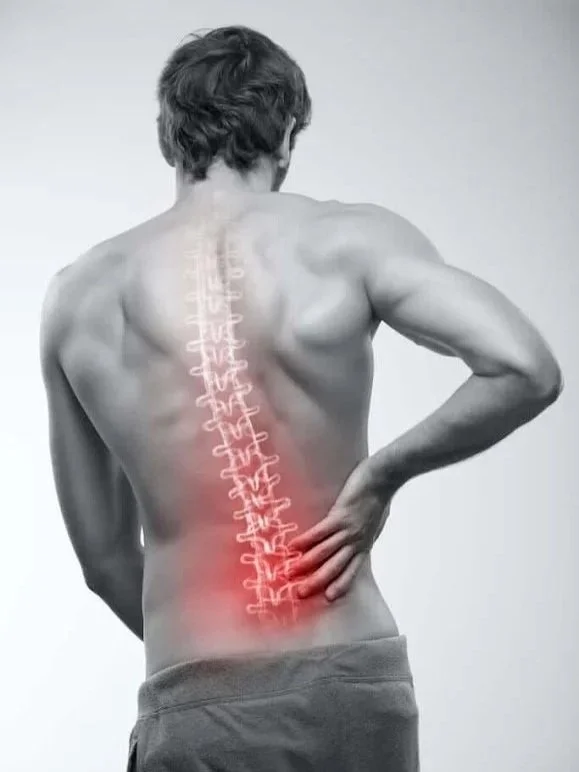
A lumbar strain and a lumbar sprain are closely related, and in practice we assess and treat them much the same way. The distinction is still worth understanding. A strain is an injury to muscle or to the tendon that anchors muscle to bone. A sprain is an injury to a ligament, the tissue that connects bone to bone and stabilizes the joints of the spine. Both happen in the same region, the dense network of muscle and connective tissue that surrounds and supports the lumbar spine, and both produce the same picture: localized pain, stiffness, and a lower back that does not want to move.
These injuries happen when the tissue is loaded beyond what it can currently tolerate. The fibers are overstretched, and in more significant cases some of them tear. It can happen in a single moment, a heavy lift, a fast rotation, a slip on the stairs, or it can build gradually as repeated loading outpaces the tissue's ability to recover between sessions. Either way, the result is a local soft-tissue injury, not damage to the spine itself.
That last point carries more weight than almost anything else on this page. A lumbar strain is a soft-tissue injury, and soft tissue is well supplied with blood and heals dependably. The fear that so often comes with lower back pain, that something structural is damaged or that the spine is fragile, does not apply to most strains. That fear is frequently what turns a short-lived injury into a long-standing problem, because it drives the avoidance and guarding that slow recovery.
“A lumbar strain is an injury to muscle or ligament, not to the spine itself. That distinction changes both how you treat it and how much you need to worry about it.”
WHY IT HAPPENED
The strain is the event. The cause is usually something else.
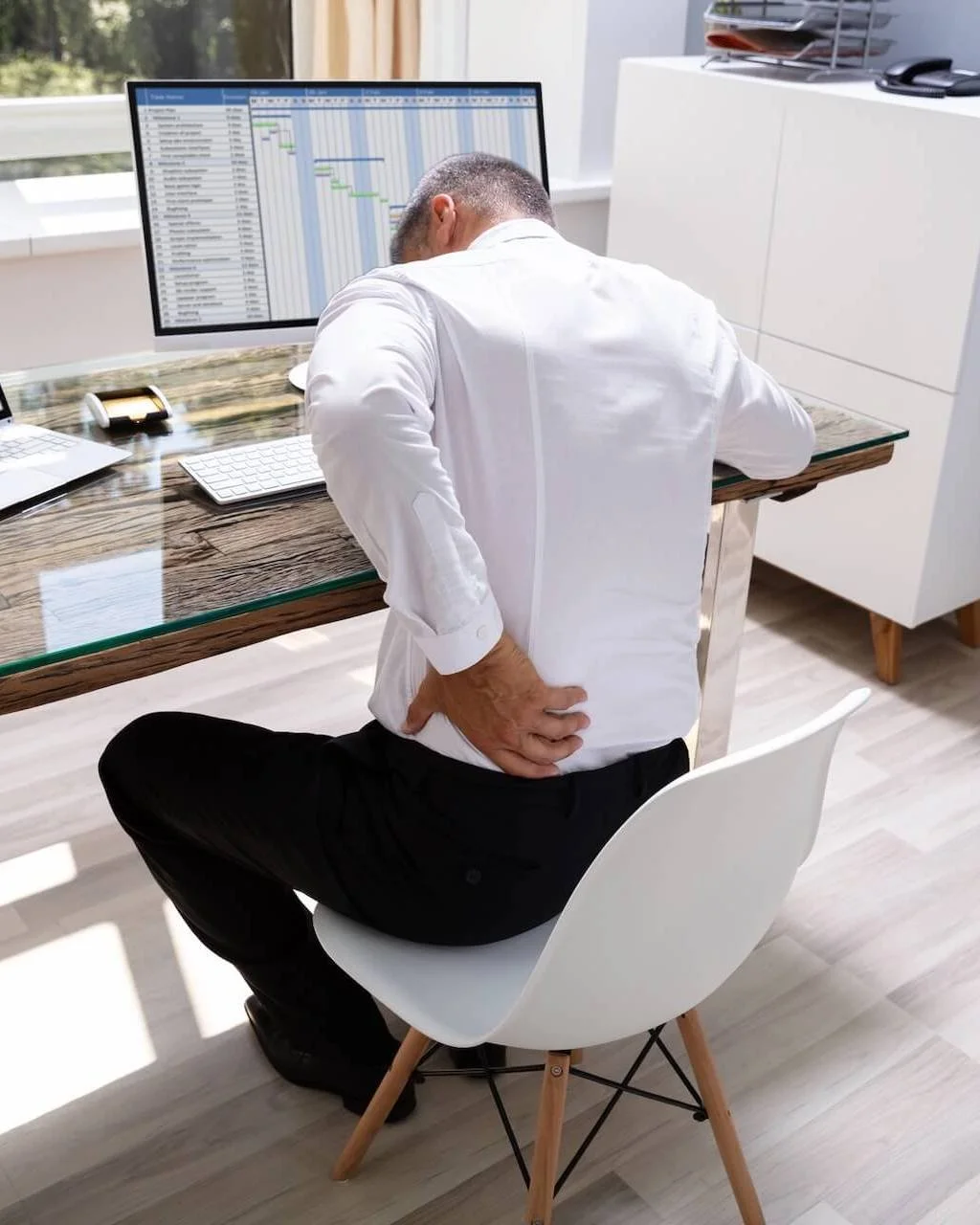
Most people can name the exact moment their back went: the rep that felt wrong, the awkward reach into the back seat, the sneeze that caught them mid-turn. That moment is real, but it is rarely the full explanation. The tissue failed at that instant because it was being asked to do more than it was prepared for, and the reason for that gap is where the actual problem usually lives.
A sudden overload is the most obvious version. A deadlift that got heavy faster than the tissue was ready for, a lift where position broke down under the weight, a moment of catching something with a rounded spine. Load exceeded capacity in a single event, and the tissue gave.
A spike in training volume is less obvious and more common than most people expect. Tissue adapts to the demands placed on it, but adaptation takes time. When weekly mileage jumps, when squat and deadlift volume climbs quickly across a new program, or when someone returns after time off and picks up where they left off rather than where they actually are, the tissue is loaded faster than it can strengthen. The strain that follows gets blamed on a single session when the real driver was the ramp that preceded it.
A recurring positional fault under repetitive load is the third pattern, and the most stubborn. A hip that does not hinge well shifts stress onto the lumbar spine on every repetition. Limited thoracic rotation forces the lower back to produce rotation it was never built to generate. Neither fault causes pain on any single rep, but across thousands of them, the tissue that keeps absorbing the compensation is the tissue that eventually fails.
Knowing which of these drove your strain is not an academic exercise. It is the difference between treating this episode and preventing the next one. A strain that resolves without its cause addressed is usually a strain that comes back.
RECOGNIZING IT
What a lumbar strain feels like
Lumbar strain symptoms are usually easy to recognize, though they can be alarming in the first day or two, given how sharply the back tends to react.
The primary symptom is localized pain in the lower back, often to one side of the spine rather than centered on it. The pain is typically sharp at the moment of injury and settles into a deep ache with marked stiffness over the hours that follow, as the surrounding muscles tighten to protect the injured tissue. That protective guarding is a normal, healthy response, but it produces a second layer of discomfort on top of the original injury, and it is frequently the more limiting of the two.
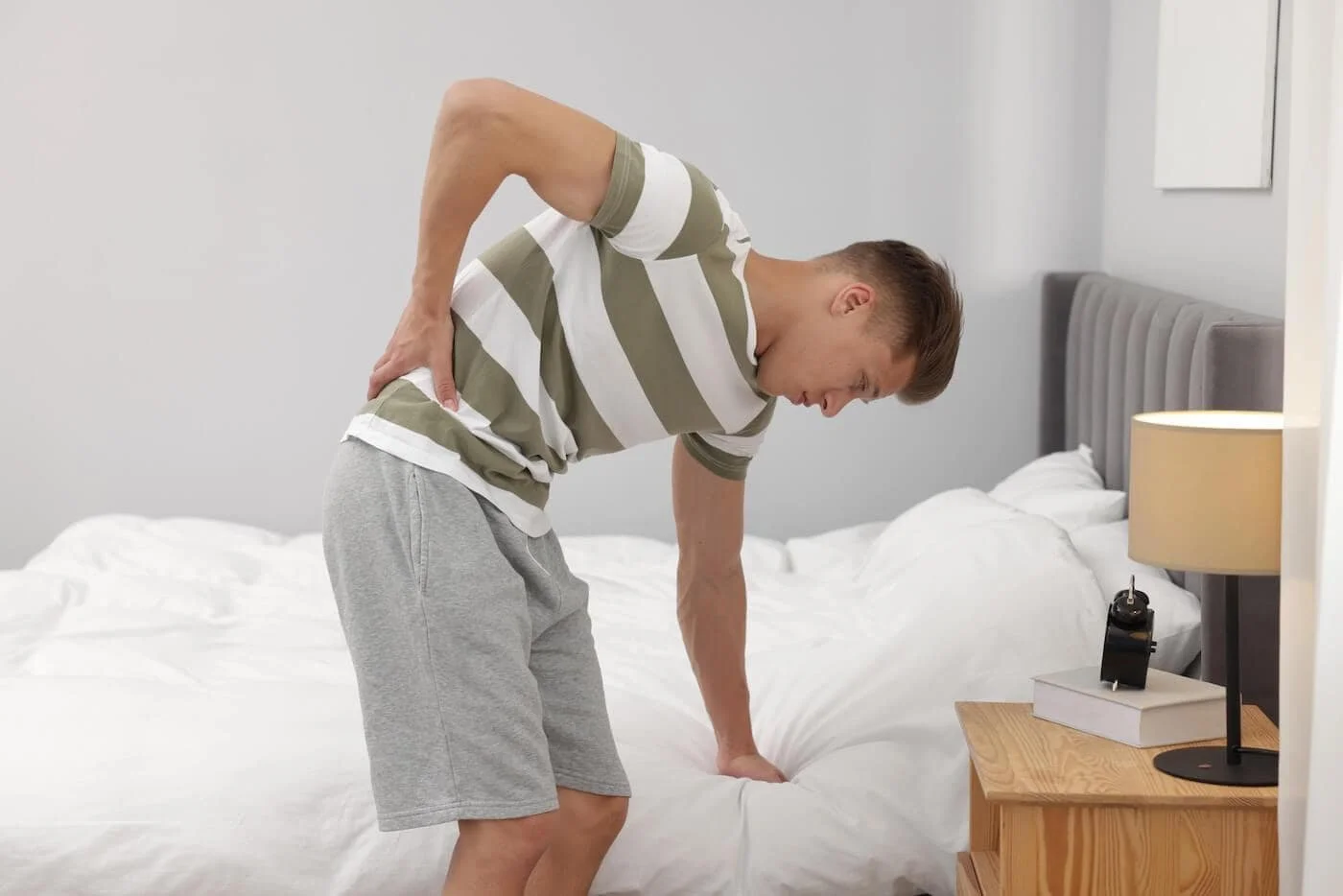
Movement provokes the pain in predictable ways. Bending forward, twisting, rising from a chair, and getting out of bed are commonly the hardest, because each asks the injured tissue to lengthen or contract under load. Coughing or sneezing can send a sharp jolt through the area. The back often feels braced or locked, and the instinct is to move as little as possible, which is understandable and, past the first day or so, usually works against recovery.
A straightforward strain stays local. The pain lives in the lower back and sometimes the neighboring muscles of the glute or hip. It does not travel down the leg, and it does not bring numbness, tingling, or weakness into the leg or foot. When those symptoms are present, the picture is no longer a simple muscle strain, which is exactly what the next point addresses.
WHEN IT IS MORE THAN A STRAIN
Pain that radiates down the leg, numbness or weakness in the leg or foot, or any change in bladder or bowel control is not a simple strain and warrants prompt evaluation by a physician. These presentations are uncommon, but they are the ones worth acting on quickly.
Is it a strain, or is it something else?
TELLING THEM APART
Because a muscle strain, a disc injury, and nerve irritation can all show up as lower back pain, and because the right treatment for each is different, distinguishing between them is one of the first jobs of a good evaluation. Symptoms alone do not deliver a definitive diagnosis, and self-diagnosing from a search engine is how a lot of people end up diligently treating the wrong problem. The table below lays out the general patterns. It is meant to orient you, not to replace an assessment.
| Muscle strain or sprain | Disc-related pain | Nerve-related pain | |
|---|---|---|---|
| Where it is | Local to the lower back, often one-sided | Central low back, can refer into the buttock | Travels along a nerve path, often down the leg |
| How it starts | Usually a specific event: a lift, twist, or slip | Sometimes an event, sometimes gradual; often worse with sustained bending or sitting | Variable; may follow a disc injury or build over time |
| What it feels like | Aching, tight, sore, with stiffness and guarding | Deep ache, sometimes sharp in certain positions | Burning, electric, or shooting, often with tingling or numbness |
| Leg symptoms | None below the buttock | Possible referral, usually not past the knee | Common past the knee, sometimes with weakness |
| What tends to ease it | Gentle movement and changing positions | Often relief in one specific direction of movement | Depends on the source; positional and nerve-specific |
1st-line
Active rehabilitation over passive rest, per the back pain evidence base
0
Cookie-cutter protocols. Every plan is built from your evaluation.
100%
One-on-one sessions with a doctorate-trained physical therapist.
HOW WE TREAT IT
How physical therapy treats a lumbar strain
Treating a lumbar strain is not a passive waiting game, and it is not an open-ended course of the same exercises handed over on day one. It is a progression. Each phase has a job, and each phase sets up the one after it. The aim is not only to settle the current episode but to close the gap that allowed it to happen in the first place.
-
01
Assess and rule out
Identify the injured tissue, screen for disc or nerve involvement, and find the movement or load factors that actually drove the strain.
-
02
Calm the acute phase
Reduce protective guarding and pain with gentle movement, position changes, and manual therapy, so the back stops bracing and starts moving again.
-
03
Restore mobility
Return normal movement to the lumbar spine and the hips and thoracic spine around it, undoing the stiffness that both the injury and the guarding created.
-
04
Rebuild strength
Progressively load the muscles that support the lumbar spine, along with the hips and deep core, building capacity beyond where it stood when the strain occurred.
-
05
Retrain the pattern
Correct the hinge, rotation, or loading fault that contributed to the injury, so the movement itself stops overloading the back.
-
06
Return to activity
Reintroduce the specific demands of your training or sport in graded steps and with a plan, rather than testing the back with a sudden return to full load.
WHAT ACTUALLY MOVES THE NEEDLE
What speeds recovery, and what stalls it
A lot of how a lumbar strain goes is decided not by the injury itself but by what happens in the days and weeks after it. A handful of choices reliably help. A handful reliably get in the way.
What speeds recovery
Gentle movement within the first day or two, staying as active as the pain reasonably allows.
Progressive loading that rebuilds strength past the pre-injury baseline.
Learning which movements are safe, which reduces fear and guarding
Addressing the hip, thoracic, and core factors that drove the strain.
Adjusting training rather than shutting it down entirely.
A plan that changes as you respond, week to week.
What stalls it
Extended bed rest, which lets the surrounding muscles stiffen, guard, and weaken.
Waiting for pain to hit zero, then returning to full load all at once.
Treating only the sore spot and ignoring why it happened.
Treating the back as fragile and avoiding movement broadly.
Full shutdown followed by an abrupt return to normal volume.
The same sheet of exercises for six weeks regardless of progress.
Built around her training,
not separate from it
“A PT friend of mine suggested I reach out to Moment for a recurring lower back injury that had been plaguing me for over 10 years. I am so impressed with Kristi. She approaches PT in a way that feels very integrated with my running and strength goals rather than separate from them. She gave me a set of exercises to do before I work out so that I am not relying on my lower back so much. Doing them reduces my pain and makes me feel less stiff, and over time I am seeing improvements to my strength and flexibility. Kristi adjusts the exercises each week to keep them challenging and targeted, and she has worked with me to adjust my training plan and improve my form so it actually serves my running and strength goals. I highly recommend Moment, and Kristi in particular.”
Hanna Wallach Recurring lower back injury, 10-plus years. Treated by Dr. Kristi Fata-Chan.
Result: A decade of recurring back pain addressed at its source, with strength, flexibility, and training all moving forward together.
Getting back to lifting, running, and training
The most costly mistake in lumbar strain recovery is usually not made in the acute phase. It is made at the return. Someone rests until the pain is gone, feels fine, and steps straight back into the training load they were carrying before the injury. The tissue that was strained has not been rebuilt to handle that load, because rest does not build tissue. It only stops provoking it. The result is a re-strain, often within a few weeks, and a slowly hardening belief that the back is simply unreliable.
Returning to load well is a graded process. The tissue needs to be progressively reloaded, starting below the level that provokes symptoms and building deliberately from there. For a lifter, that means returning to the hinge and the squat with reduced load and clean position, then adding weight as the tissue proves it can handle it, rather than chasing the old numbers immediately. For a runner, it means reintroducing volume in steps and watching how the back responds to the repetitive loading of the stride, rather than resuming full weekly mileage in a single week.
This is where the underlying cause matters most. If a hip that does not hinge or a core that does not stabilize contributed to the strain, the return-to-training phase is where those get addressed under real load, not in isolation. Our therapists train with barbells and work with runners, and we assess your movement in the context of what you actually do rather than in a clinical vacuum. The objective is not simply to return you to where you were before the strain. It is to return you more capable than you were, so the same injury stops finding you.

“A lumbar strain heals. What decides whether it comes back is not the injury. It is whether the strength and movement that allowed it were ever addressed”
FREQUENTLY ASKED QUESTIONS
Lumbar strain questions, answered
-
There is no single honest number, because recovery depends on how significant the strain is, your baseline strength and conditioning, and what you do while it heals. A mild strain can settle within days. A more significant one takes longer. What reliably shortens the process is early, gentle movement rather than extended rest, followed by progressive loading. What lengthens it is fear-driven avoidance and a sudden return to full activity the moment the pain fades. A more useful question than how long until the pain is gone is how long until the tissue is strong enough that the strain does not return, and that answer depends on the rehab, not the calendar.
-
IFor the first day or two, some relative rest is reasonable while the sharpest pain settles. Beyond that, movement is the better choice, and the evidence on this is consistent. Staying still lets the muscles around the injury guard and stiffen, which adds a layer of pain and slows recovery. Gentle, pain-respecting movement keeps the tissue mobile and the surrounding muscles working. This does not mean pushing through significant pain. It means not treating the back as something that has to be kept still in order to heal, because it does not.
-
A straightforward lumbar strain stays local to the lower back and the muscles right around it. It hurts to move in certain ways, but the pain does not travel down the leg, and there is no numbness, tingling, or weakness in the leg or foot. When any of those appear, or when there is any change in bladder or bowel control, the problem is likely beyond a simple strain and should be evaluated promptly. Short of those signs, the reliable way to know is an assessment, because the specific pattern of what provokes and relieves your pain tells a trained clinician a great deal that symptoms alone do not.
-
Recurring strains almost always point to a cause that was never addressed. The original strain healed, but the factor that produced it, a hip that does not hinge well, a core that does not stabilize under load, a training volume that outpaced the tissue's capacity, stayed exactly the same. So the same tissue keeps absorbing the same excess stress and keeps failing in the same way. Breaking the cycle means finding that driver and building the strength and movement to remove it, which is precisely what resting until it feels better never does.
-
Usually yes, with modification, and training intelligently is often better than stopping outright. The key is to reduce load and adjust the specific movements that provoke symptoms while continuing to move and train the parts of your body that are not involved. Full shutdown tends to backfire, because it deconditions you and sets up the abrupt return that causes re-injury. A good plan keeps you as active as the injury reasonably allows and rebuilds the provoking movements in steps rather than removing them for good.
-
Neither one changes how fast the tissue heals, so it helps to treat both as comfort tools rather than cures. Ice can take the edge off in the first day or two if the area feels sharp or hot. Heat tends to feel better after that, when the main problem is muscular stiffness and guarding, because it helps those muscles relax enough to let you move. Use whichever lets you move more comfortably, and keep the focus on the movement itself, since that is the part actually driving recovery.
-
Sooner is better than later, especially if this is not your first strain. A therapist can confirm that what you have is in fact a strain rather than something that needs different management, guide the acute phase so you recover faster and carry less unnecessary fear, and, most importantly, find and fix the cause so the strain does not become a recurring feature of your life. If the pain is severe, not improving after a week or so of sensible self-management, or keeps returning, an evaluation is worth the visit.
Moment Physical Therapy and Performance | Midtown Manhattan | SoHo | Long Island City, Queens