

IT Band Syndrome Treatment in NYC
IT band syndrome is not a tight band that needs to be stretched or rolled. It is a compression problem driven by hip weakness and training load. Expert treatment in New York City built around fixing the mechanics that created it, not the tissue that is complaining about it.
UNDERSTANDING THE CONDITION
What is IT band syndrome?
The iliotibial band, commonly called the IT band, is a thick band of connective tissue that runs from the hip down the outside of the thigh and attaches just below the outside of the knee. IT band syndrome is an overuse condition in which this structure becomes irritated at its attachment near the knee, producing sharp or burning pain on the outer side of the joint.
The condition is almost always activity-related and appears with striking consistency at a predictable point in an activity. Runners frequently describe pain that appears at the same mile marker in every run. Cyclists describe pain that develops after a consistent amount of time in the saddle. This predictability is one of the most recognizable clinical features of IT band syndrome and is a useful diagnostic clue in itself.
For years, the condition was explained as a friction problem, the IT band rubbing back and forth over a bony prominence on the outside of the knee called the lateral femoral epicondyle. More recent research has refined this understanding. The IT band is firmly attached to the femur along most of its length and does not actually slide back and forth the way the friction model suggested. What happens instead is compression: a layer of richly innervated, pain-sensitive fat and connective tissue beneath the IT band gets compressed against the femur at a specific angle of knee flexion, and that compression is what generates the pain.
This distinction matters enormously for treatment. A friction problem might reasonably be treated by stretching or rolling the band to reduce rubbing. A compression problem is not solved by stretching the structure doing the compressing. It is solved by reducing the compression, which comes from fixing the mechanics that are creating it.
RECOGNIZING IT
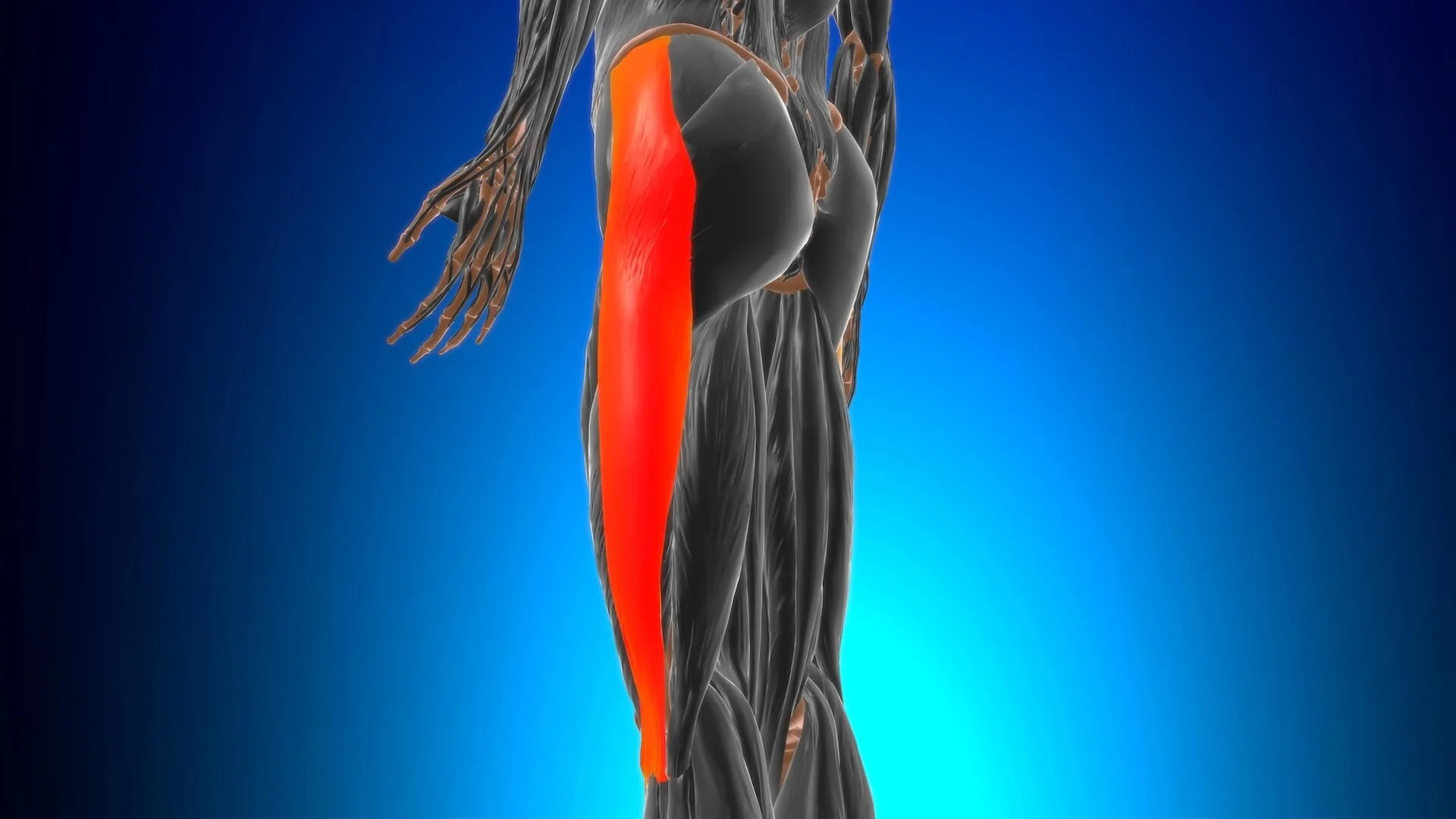
Symptoms of IT band syndrome
IT band syndrome has a distinctive symptom pattern that usually allows for confident clinical diagnosis based on history and physical examination, without imaging.
The hallmark symptom is a sharp, burning, or stabbing pain on the outside of the knee, typically located about two centimeters above the joint line. In the early stages, pain appears after a consistent and predictable amount of activity, often at the same point in a run or ride, and settles relatively quickly once the activity stops. As the condition progresses without treatment, pain can begin earlier in activity, persist longer afterward, and eventually interfere with walking, stairs, or getting in and out of a car.
Other common features include tenderness to direct pressure over the lateral femoral epicondyle, a sensation some runners describe as a clicking or snapping at the outside of the knee during activity, and pain that is often worse running downhill, since downhill running increases the knee flexion angle at which compression is greatest. Pain is typically absent or minimal during activities that do not repeatedly cycle the knee through the compression-prone range, such as swimming or upper body strength work.
Unlike patellofemoral pain, which tends to be more diffuse and centered around or behind the kneecap, IT band syndrome pain is usually well-localized to a specific point on the outside of the knee, which is one of the clearest ways to distinguish between the two conditions during an evaluation.
Sports and activities most commonly affected
WHO GETS IT
IT band syndrome is almost exclusively an overuse injury, and it develops through the same fundamental mechanism regardless of the sport: repetitive knee flexion and extension under load, performed at a volume that exceeds the tissue's current capacity to tolerate the compressive forces involved.
In runners, the condition is heavily associated with recent increases in training volume, a change in running surface such as moving to a cambered road or a banked track, and returning to running after a period of reduced activity. Downhill running is a particularly strong provocateur because it increases both the knee flexion angle during stance and the eccentric demand on the muscles that control that flexion, both of which increase compressive load on the structures beneath the IT band.
In cyclists, IT band syndrome is closely tied to bike fit. A saddle height that is too high, a saddle that is positioned too far forward, or cleats that are not aligned with the rider's natural foot rotation can all increase the degree of hip adduction and internal rotation during the pedal stroke, which increases tension and compression at the lateral knee across thousands of repetitions per ride.
What both populations share is the underlying vulnerability that turns normal training volume into an overuse injury: insufficient hip strength and control. A runner or cyclist with strong, well-coordinated hip abductors and external rotators can tolerate significantly more repetitive knee flexion before compression at the IT band becomes symptomatic. This is why two athletes with similar training volumes can have completely different experiences, one developing IT band syndrome and the other not.
Related: Common Running Injuries momentptp.com/common-running-injuries
THE UPSTREAM DRIVER
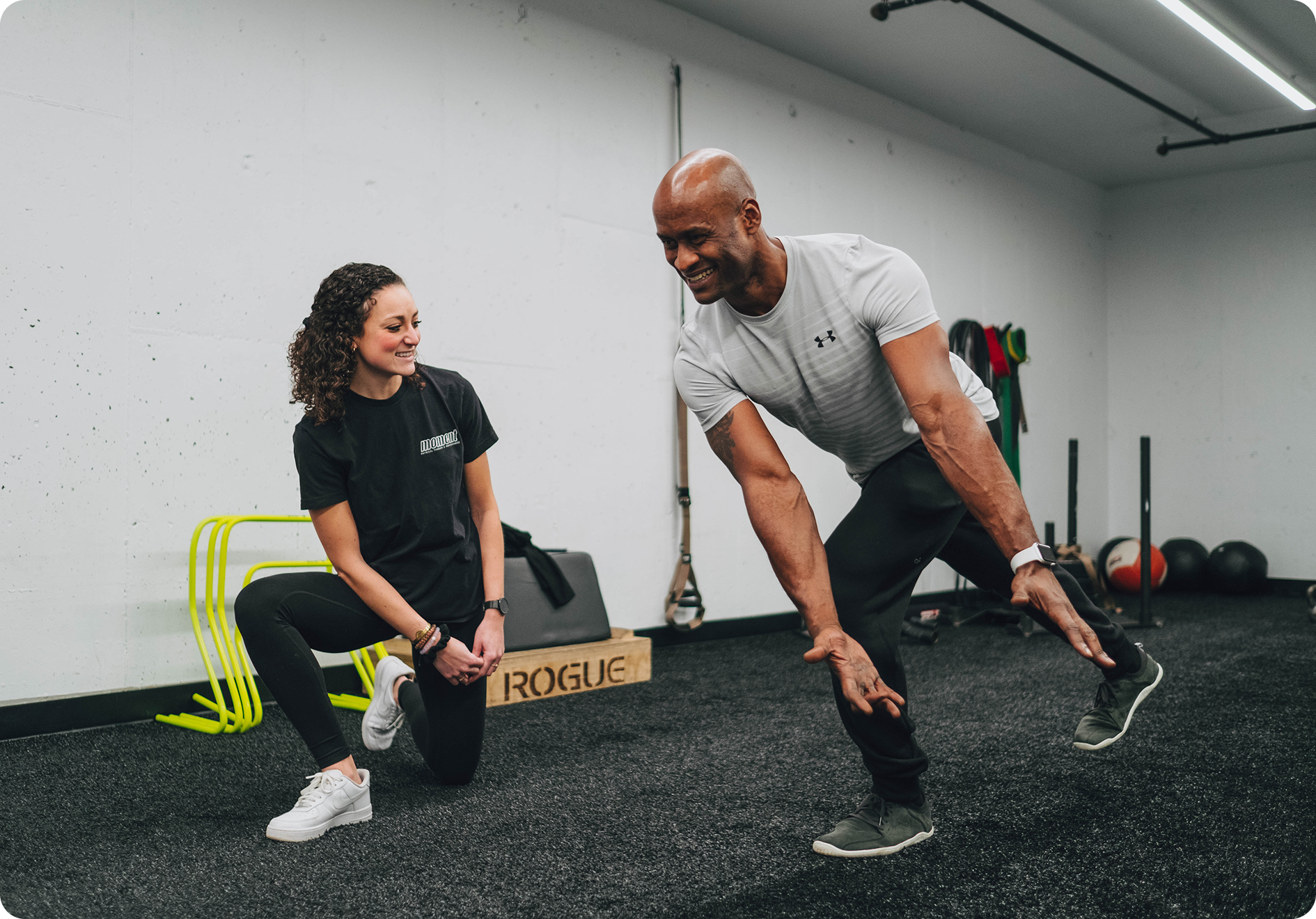
Hip strength and IT band syndrome
he research linking hip weakness to IT band syndrome is among the most consistent findings in running injury literature. Runners with IT band syndrome reliably demonstrate weaker hip abductor strength on the affected side compared to both their uninjured side and to pain-free runners with comparable training volume.
The mechanical explanation is straightforward. The gluteus medius and the posterior fibers of the gluteus maximus are responsible for controlling the position of the femur relative to the pelvis during the single-leg stance phase of running and cycling. When these muscles are not producing adequate force, the femur adducts and internally rotates more than it should during loading. This subtly changes the angle at which the IT band crosses the lateral knee and increases the compressive load on the tissue beneath it with every stride or pedal stroke.
This is why a course of generic quad strengthening or a stretching program aimed at the IT band itself so often fails to resolve the condition. Neither addresses the actual mechanical deficit. The muscles that need to be strengthened are specific: the gluteus medius, which resists pelvic drop during single-leg stance, and the posterior gluteus maximus, which controls femoral rotation. Standard hip abduction exercises performed in a non-weight-bearing position build some capacity but often fail to transfer to the demands of single-leg loading during running, which is why the exercise selection and progression matter as much as the general instruction to strengthen the hip.
THE CLINICAL REALITY MOST PATIENTS ARE NOT TOLD
IT band syndrome that keeps returning after rest almost always reflects a hip strength deficit that was never actually corrected. Pain resolves temporarily when load is removed. It returns when load resumes, because the mechanical vulnerability that allowed the compression to develop is still there.
BIOMECHANICS
Hip weakness sets the stage for IT band syndrome, but the mechanics that actually produce the compression during running are specific and identifiable. Watching a runner move under real training conditions, not standing still in a clinic, is what reveals these patterns.
| Contributing Factor | Why It Increases Load | How We Address It |
|---|---|---|
| Pelvic drop | Contralateral hip drop during single-leg stance increases hip adduction on the stance leg, sharpening the angle of IT band compression against the femur | Gluteus medius strengthening with single-leg loading progressions, gait cueing for pelvic control |
| Excessive hip adduction | The stance leg crosses toward the midline more than it should, increasing tension and compressive load at the lateral knee on every stride | Hip abductor strengthening, step width cueing, running form retraining |
| Increased knee flexion at contact | Runners who overstride or land with excessive knee bend spend more time in the flexion range where IT band compression is greatest | Cadence training, landing mechanics retraining, stride length adjustment |
| Rearfoot overpronation | Excess pronation increases tibial internal rotation, which compounds with femoral internal rotation to worsen lateral knee compression | Foot and ankle strengthening, gait analysis, footwear assessment |
| Downhill running mechanics | Increased knee flexion angle and greater eccentric quad demand during descent both raise compressive load at the lateral knee | Graded downhill exposure, eccentric strength training, pacing strategy for downhill sections |
Running gait analysis at your actual training pace, and ideally under the same fatigue conditions present when your symptoms typically appear, is the most valuable tool for identifying which of these patterns is driving your specific case. A runner whose IT band syndrome appears at mile eight is compensating in ways that are often invisible in the first mile, which is why assessment under fatigue matters more for this condition than almost any other running injury.
HOW WE TREAT IT
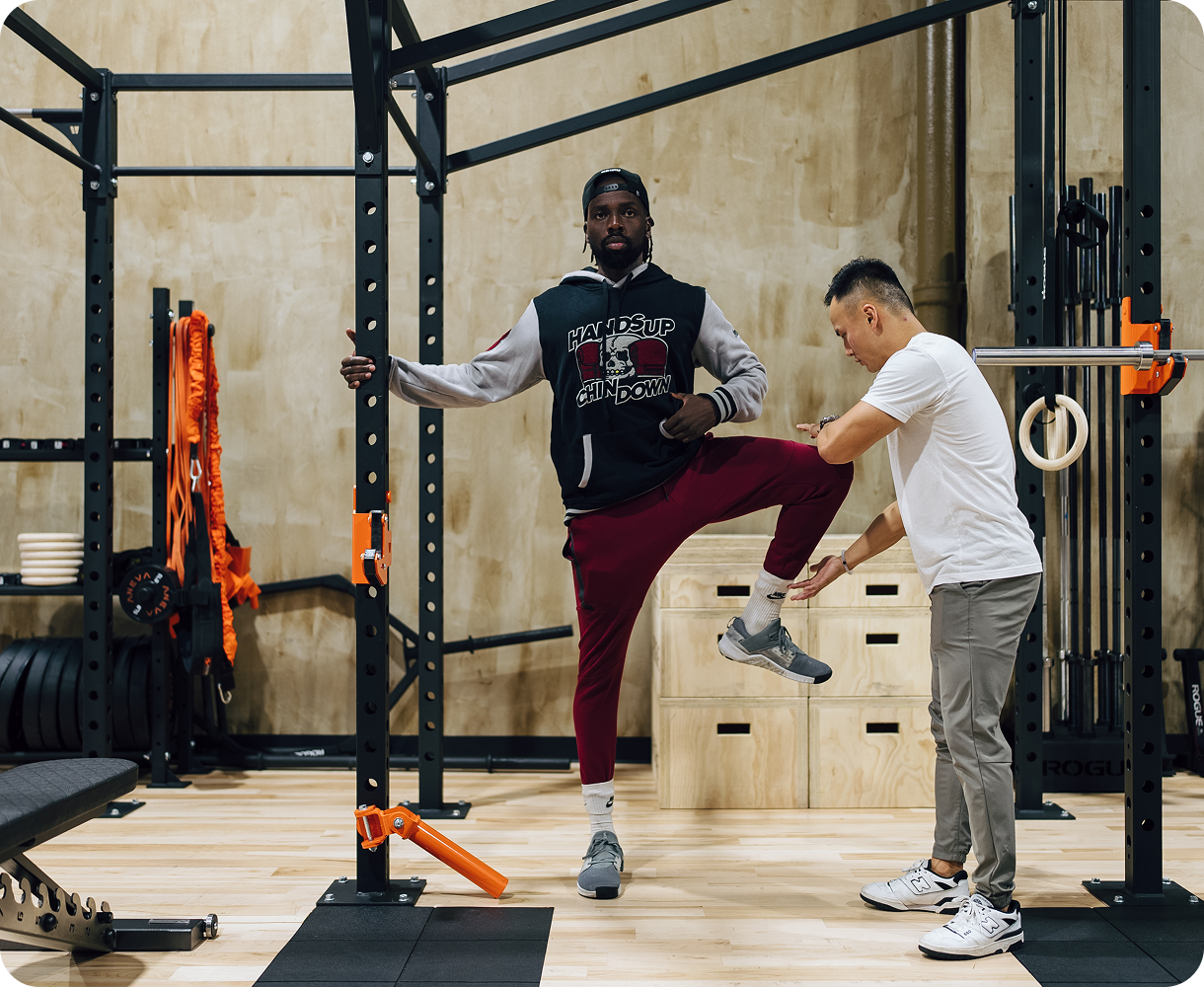
Treatment for IT band syndrome
Effective treatment for IT band syndrome addresses the compression mechanism directly rather than attempting to stretch or release the IT band itself, an approach that has limited evidentiary support given that the band is not a contractile structure and does not lengthen meaningfully with stretching.
The first priority in an irritable presentation is reducing the load that is provoking symptoms. This does not typically mean complete rest. It usually means a temporary reduction in the specific variables driving compression, mileage, hill work, or pace, to a level that allows the irritated tissue to settle while rehabilitation begins. Complete cessation of running for weeks, followed by a return to full previous volume, tends to reproduce the same injury because the underlying mechanical deficit was never addressed during the time off.
The second and most important component is progressive strengthening of the gluteus medius and posterior gluteus maximus, performed through exercises that specifically train single-leg control rather than isolated hip abduction in a side-lying position. Side-lying leg raises have a place early in rehabilitation but must progress to standing and single-leg loaded variations that replicate the demands of running and better transfer to gait mechanics.
The third component is movement retraining. Strengthening the hip in the clinic does not automatically change what the hip does during running. Gait-specific cueing, often using real-time feedback during treadmill running, helps translate improved hip strength into the reduced pelvic drop and hip adduction that actually decrease IT band compression during activity.
Manual therapy has a role in the acute phase, targeting the surrounding musculature and the compressed tissue beneath the IT band to reduce irritability and improve comfort during the early rehabilitation period. It is a supportive tool, not the primary driver of resolution, which is why treatment approaches built primarily around foam rolling and manual release without a structured strengthening component tend to produce temporary relief followed by recurrence.
Preventing IT band syndrome
For runners and cyclists who have resolved a previous episode of IT band syndrome, or who want to reduce their risk before symptoms ever develop, prevention centers on the same principles that drive treatment: adequate hip strength, sound training progression, and attention to the specific loading variables that most commonly trigger the condition.
STAYING AHEAD OF IT
| Progressive mileage increases Keep weekly mileage increases within a reasonable range and avoid stacking a volume increase with a change in terrain or intensity in the same week. | Ongoing hip strength work Gluteus medius and posterior gluteus maximus strengthening should be a standing part of a runner's or cyclist's training program, not something addressed only after symptoms appear. |
| Graded downhill exposure If your training or racing includes significant downhill running, build exposure to it gradually rather than encountering a large amount for the first time in a race or a single hard session. | Bike fit assessment For cyclists, a professional bike fit that addresses saddle height, saddle position, and cleat alignment reduces the repetitive mechanical stress that predisposes to IT band irritation. |
| Address early symptoms promptly A mild ache that appears at a predictable point in a run and is dismissed as normal training discomfort frequently progresses to a condition that limits training entirely. Early intervention is significantly more effective than treatment after the condition has become established. | Periodic gait reassessment As training volume and goals change over a season, the mechanical patterns that were fine at lower volumes can become provocative at higher volumes. Periodic reassessment catches this before it becomes symptomatic. |
FREQUENTLY ASKED QUESTIONS
Common questions about IT band syndrome
-
Foam rolling the IT band itself has limited evidence of benefit and does not address the underlying mechanism of the condition. The IT band is a dense fibrous structure that does not lengthen meaningfully with rolling or stretching. Foam rolling may provide temporary symptomatic relief by affecting the surrounding musculature, but it does not correct the hip weakness and movement mechanics that are actually driving the compression. It should not be relied on as a primary treatment strategy.
-
Often yes, with modification. The key is reducing the specific training variables, typically volume, hill work, or pace, that are provoking symptoms to a tolerable level while strengthening and movement work address the underlying mechanical deficit. Complete cessation of running is rarely necessary and, without addressing the hip strength and mechanics issues during time off, frequently leads to the same symptoms returning once running resumes.
-
With appropriately targeted rehabilitation, most runners see meaningful improvement within four to six weeks and are able to return to full training within six to ten weeks. Cases that have been present for many months before treatment begins, or that have gone through multiple rest-and-return cycles without addressing hip strength, tend to take longer to resolve fully. The timeline depends heavily on how quickly hip strengthening translates into measurable changes in running mechanics.
-
Both are common overuse conditions in runners with hip weakness as a significant contributing factor, but the location and mechanism differ. IT band syndrome produces well-localized pain on the outside of the knee from compression of tissue beneath the IT band. Runner's knee, or patellofemoral pain syndrome, produces pain behind or around the kneecap from altered tracking of the patella. An evaluation that includes running gait analysis reliably distinguishes between the two, which matters because the specific strengthening and movement retraining emphasis differs between them.
-
This predictable onset pattern is one of the most characteristic features of IT band syndrome and reflects a fatigue-dependent mechanism. As the run progresses, the hip stabilizers fatigue and their ability to control pelvic and femoral position during single-leg stance declines. Once that control drops below a certain threshold, compression at the lateral knee crosses into symptomatic territory. This is also why gait analysis performed only in the first mile of a run, before fatigue sets in, often misses the mechanical breakdown that is actually driving the condition.
-
Not typically. IT band syndrome is usually diagnosed clinically based on the characteristic symptom pattern, location of pain, and physical examination findings, including tenderness at the lateral femoral epicondyle and reproduction of symptoms with specific provocation tests. Imaging is generally reserved for cases that are not responding as expected to appropriate treatment or where another diagnosis is suspected.
-
Yes. IT band syndrome is common in cyclists and develops through a similar compressive mechanism during the repetitive knee flexion and extension of the pedal stroke. In cyclists, bike fit is a particularly important contributing factor. Saddle height, saddle position, and cleat alignment all influence the degree of hip adduction and rotation during pedaling, and correcting a poor fit is often an essential part of resolving cycling-related IT band syndrome alongside hip strengthening.
-
Hip strengthening is necessary but often not sufficient on its own. Strength gained in the clinic needs to translate into changed movement patterns during running or cycling, which requires deliberate movement retraining alongside the strengthening program. Runners who complete a strengthening program without addressing gait mechanics sometimes see partial improvement that does not fully resolve symptoms once training volume increases. The combination of strength and movement retraining consistently produces better and more durable outcomes than either approach alone.
Moment Physical Therapy and Performance | Midtown Manhattan | SoHo | Long Island City, Queens