

Post-Surgical Knee Rehabilitation in NYC
The surgery repairs the structure. Rehabilitation determines whether you get your knee back. Criteria-driven post-surgical rehab in New York City for ACL reconstruction, meniscus repair, total knee replacement, and every procedure in between.
UNDERSTANDING YOUR PROCEDURE
Common knee surgeries and what they mean for rehab
Not all knee surgeries are the same, and the rehabilitation approach has to reflect the specific procedure that was performed, the tissue that was involved, and the healing constraints that come with it. What is consistent across all of them is this: the surgery addresses the structural problem. It does not rebuild strength, mobility, or the neuromuscular control needed to return to full activity. That work happens in rehabilitation, and how well it is done determines your outcome as much as the surgery itself.
| Surgery | Typical Reason | Key Early Consideration |
|---|---|---|
| ACL reconstruction | Complete ACL tear in an athlete with high rotational or pivoting demands | Graft type determines early loading restrictions. Nine to twelve months to full return to sport. |
| Meniscus repair | Traumatic tear in the vascular zone with healing potential, often in younger patients | Weight-bearing and flexion restrictions in early weeks to protect the repair while it heals. |
| Partial meniscectomy | Removal of torn meniscal tissue that cannot be repaired or does not have healing potential | Faster early recovery since there is no repair to protect, but long-term joint health requires attention. |
| Total knee replacement | End-stage osteoarthritis or joint damage where the joint surfaces are replaced with an implant | Early and aggressive range of motion work is critical. Stiffness that sets in early is hard to reverse later. |
| Cartilage restoration | Focal cartilage defects, often in younger active patients wanting to preserve the joint | Extended protected weight-bearing phase, often longer than other knee procedures, to allow the repair to mature. |
| Patellar or quad tendon repair | Complete rupture of the tendon connecting the kneecap to the quad or shin | Extension is protected early. Regaining full knee flexion is often the slowest part of recovery. |
Regardless of which procedure you have had, we coordinate directly with your surgeon and follow the protocol-informed restrictions specific to your surgery while making every decision beyond those restrictions based on how your knee is actually responding.
WHAT TO EXPECT
Recovery timeline after knee surgery
Recovery timelines vary significantly by procedure, but the general arc of post-surgical knee rehabilitation follows a consistent structure. Understanding the phases helps set realistic expectations and makes clear why rushing any one of them tends to cost more time than it saves.
| Phase 1 Weeks 1–3 | Protect and settle | Manage swelling and pain, protect the surgical site per your surgeon's restrictions, restore basic range of motion, prevent significant quad shutdown. |
| Phase 2 Weeks 3–8 | Rebuild the foundation | Progressive range of motion to full, early strengthening of the quad and hip, normalize walking gait, begin closed-chain loading as restrictions allow. |
| Phase 3 Weeks 8–16 | Build real strength | Progressive resistance training, single-leg strength and stability work, low-impact cardiovascular conditioning, address any lingering asymmetries. |
| Phase 4 Months 4–8 | Reload for demand | Sport or activity-specific loading, running progression where appropriate, plyometric and reactive training for athletes, strength testing against the uninjured side. |
| Phase 5 Months 6–12 | Return to full activity | Objective clearance based on force plate and dynamometer testing , full return to sport or training, transition to a maintenance strength program. |
These timeframes are general and vary considerably by procedure. A total knee replacement patient returning to walking and daily activity without restriction has a very different timeline than an athlete pursuing an ACL reconstruction return to competitive sport. What does not vary is the principle that progression through each phase should be earned through how the knee is actually performing, not simply because a certain number of weeks have passed.
THE FIRST PRIORITY

Restoring mobility after knee surgery
Range of motion is the first and most urgent priority after almost any knee surgery, and it is also the area where early neglect creates problems that are disproportionately difficult to fix later. Scar tissue and joint stiffness that are allowed to set in during the first several weeks after surgery can take months of additional work to resolve, work that would have taken a fraction of the time if addressed immediately.
This is particularly critical after total knee replacement, where the combination of surgical trauma and the body's healing response create a strong tendency toward stiffness. Patients who do not achieve adequate range of motion within the first six weeks after a total knee replacement are significantly more likely to have lasting motion deficits regardless of how much work is done afterward. This is why early, consistent, and sometimes uncomfortable range of motion work in the first weeks is not optional. It is one of the highest-leverage things that happens in the entire rehabilitation process.
After ligament reconstructions and meniscus repairs, the priority is regaining full extension first, since a persistent flexion contracture, meaning an inability to fully straighten the knee, creates lasting gait abnormalities and places abnormal stress on the joint. Flexion range is restored progressively and in coordination with the tissue protection guidelines specific to the procedure.
The range of motion you have at six weeks after surgery is a strong predictor of the range of motion you will have at six months. Early, consistent, well-executed mobility work is not a formality. It is one of the most important determinants of your long-term outcome.
GETTING BACK TO RUNNING
Return to running after knee surgery
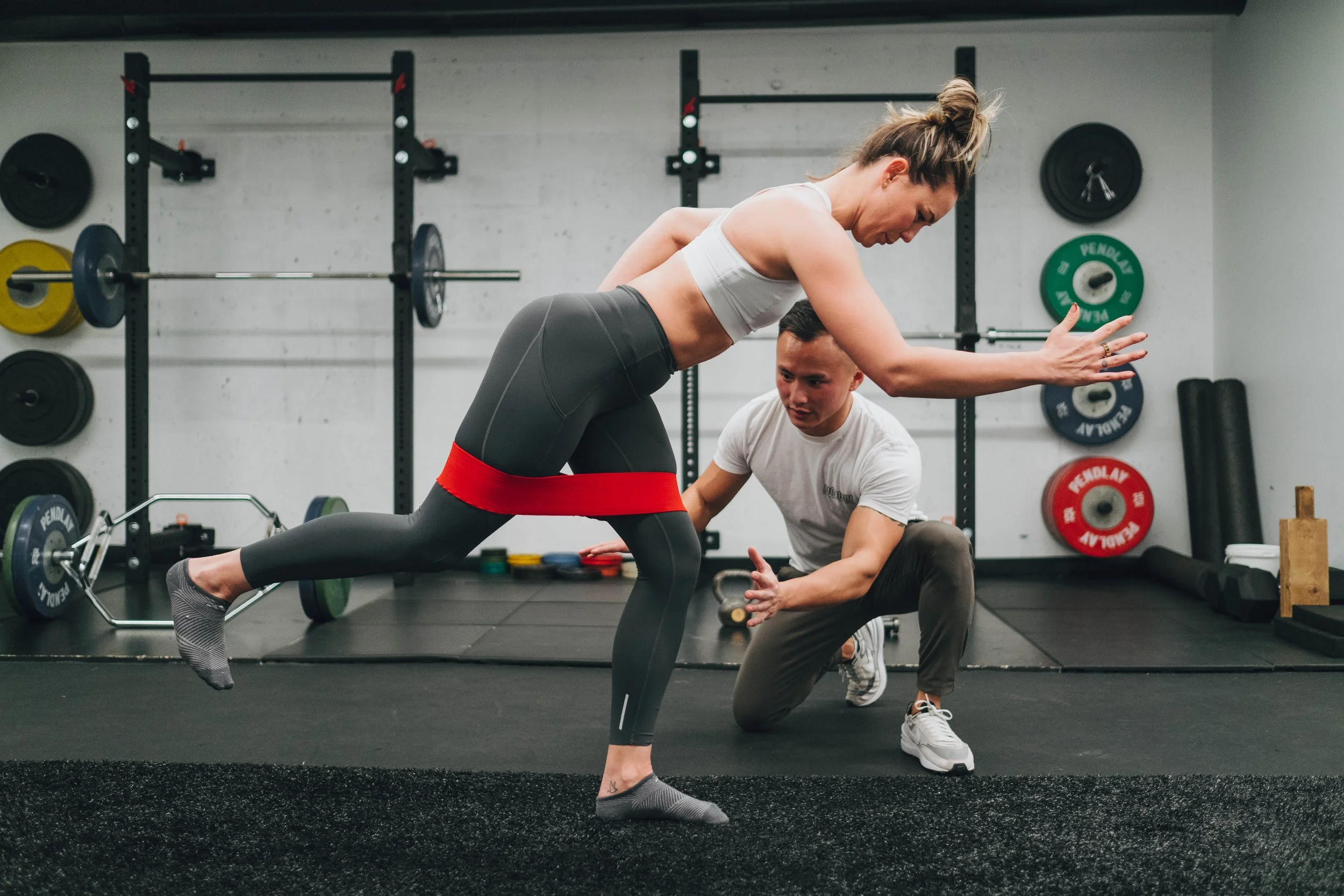
Return to running is one of the most anticipated milestones in post-surgical knee rehabilitation and one of the most commonly rushed. Running places significantly higher load on the knee than walking, with peak forces during running stance phase reaching several times body weight, which means the tissue needs to have rebuilt meaningful strength and load tolerance before running is appropriate.
At Moment, the decision to begin a return-to-running progression is based on meeting specific strength and functional criteria rather than an arbitrary date on the calendar. These typically include a minimum threshold of quad strength symmetry compared to the uninjured leg, the ability to perform single-leg squats and hops without pain or compensation, and full, pain-free range of motion.
Once cleared to begin, running is reintroduced through a graduated protocol that starts with run-walk intervals at low intensity and low volume, and progresses systematically based on how the knee responds. Swelling, pain during or after running, and any change in gait mechanics are all monitored closely during this phase, since the return-to-running period is when overzealous progression most commonly produces a setback.
For runners with specific race goals, we build the running progression around the training calendar where the timeline allows, working to get you not just running again but training again with purpose.
Return to sport after knee surgery
GETTING BACK TO COMPETITION
Return to sport is the final and highest-demand phase of post-surgical knee rehabilitation, and it is where the consequences of an inadequate rehabilitation process most often show up, either as a failure to perform at the previous level or as a second injury.
The movements required in most sports, cutting, pivoting, jumping, landing, and rapid deceleration, place the knee under far greater and more variable stress than running in a straight line. An athlete can pass a return-to-running assessment and still be significantly underprepared for the reactive, multi-directional demands of their sport. This is why return-to-sport testing at Moment goes beyond basic strength symmetry and includes sport-specific movement quality assessment: how the knee behaves during single-leg landing, how quickly and safely the athlete can change direction, and whether movement patterns under fatigue hold up to the standard required for safe competition.
The specific timeline for return to sport varies by procedure and by the demands of the athlete's sport, but the standard we apply does not vary: an athlete returns to sport when the objective data confirms readiness, not when a specific number of months have elapsed.
THE MOMENT STANDARD

The single most important principle in post-surgical knee rehabilitation, across every procedure we treat, is that return-to-activity decisions should be based on what can be measured, not on how the knee feels or how much time has passed since surgery.
This matters because subjective readiness and objective readiness are frequently not the same thing. An athlete can feel confident, train hard, and perform well on bilateral exercises while still carrying a significant strength deficit on the surgical side, a deficit that only becomes apparent when the two legs are tested independently. Quad strength asymmetries of 20-30% are common in patients who feel ready to return to sport and are precisely the kind of deficit that predicts a higher risk of reinjury or compensatory injury elsewhere.
At Moment, we use dynamometer testing to measure the precise force output of the surgical leg compared to the uninjured leg and to validated benchmarks for age, sex, and sport. We use force plate testing to assess landing mechanics, power output, and limb symmetry during functional and sport-specific tasks including single-leg hop, triple hop, and jump-landing assessments. These are not optional extras. They are how we know, rather than guess, that a knee is ready for the next phase.
THE STANDARD WE HOLD EVERY PATIENT TO
You do not advance to the next phase because the calendar says so. You advance because the data says you are ready. This is true whether you are a competitive athlete returning to sport or an active adult returning to daily life without limitation.
Why objective testing matters more than how you feel
FREQUENTLY ASKED QUESTIONS
Common questions about post-surgical knee rehabilitation
-
For most knee surgeries, physical therapy begins within the first week after the procedure, sometimes within days. Early mobility and quad activation work is one of the most important predictors of a good long-term outcome, particularly after total knee replacement, where early stiffness is disproportionately difficult to reverse later. Your surgeon will provide specific guidance on when to start based on your procedure, and we coordinate directly with that guidance.
-
It depends significantly on the procedure. Return to daily activity without restriction after a total knee replacement or meniscectomy is often achievable within six to twelve weeks. Return to full competitive sport after an ACL reconstruction typically takes nine to twelve months. What matters more than the general timeline for your specific procedure is meeting objective strength and functional criteria at each phase rather than progressing based on time alone.
-
Quadriceps weakness after knee surgery is common and often more persistent than patients expect, partly because the nervous system actively inhibits the quad as a protective response to joint trauma and effusion, not just because of simple deconditioning. This inhibition can persist well beyond the point where the surgical site itself has healed, which is why quad strengthening remains a central focus of rehabilitation for months, not just weeks, after surgery.
-
Some elements of a post-surgical program can be performed independently, but the early weeks after surgery, when range of motion and swelling management are most critical and small technique errors can meaningfully affect outcomes, benefit significantly from hands-on guidance and real-time feedback. Later phases that involve progressive strength testing and return-to-sport criteria require objective measurement tools, like dynamometer and force plate testing, that are not available in a home setting.
-
Some swelling is expected for weeks to months after knee surgery and generally decreases progressively with appropriate activity and recovery. Swelling that increases significantly, is accompanied by warmth and redness, or is associated with fever can indicate a complication and should be evaluated promptly by your surgeon. Persistent low-grade swelling that fluctuates with activity level is common during rehabilitation and is one of the variables we monitor closely when deciding how quickly to progress your program.
-
Progressing too fast typically shows up as increased swelling, pain that worsens rather than improves after activity, or a decline in range of motion after a period of gains. Progressing too slowly shows up as a persistent gap between your strength and mobility milestones and what is typical for your timeframe after surgery. Regular reassessment, including objective testing at key milestones, is how we calibrate the pace of your program to your specific healing response rather than a generic schedule.
-
Objective testing is valuable for any patient, not just competitive athletes. Strength asymmetries that predict reinjury risk in athletes are the same asymmetries that predict falls, compensatory pain in other joints, and incomplete functional recovery in active adults. Whether your goal is returning to a specific sport or simply moving through daily life without limitation or fear of your knee giving out, objective data gives us a much clearer picture than symptoms alone.
-
Incomplete rehabilitation is one of the most common reasons for a disappointing surgical outcome despite a technically successful procedure. Patients who stop physical therapy once pain has resolved but before strength and movement quality have been fully restored often experience persistent weakness, altered movement patterns, and a higher risk of reinjury or of developing compensatory problems in the hip, the other knee, or the lower back. The surgery addresses the structure. Completing rehabilitation is what determines whether that structural repair translates into lasting function.
Moment Physical Therapy and Performance | Midtown Manhattan | SoHo | Long Island City, Queens